
Showing posts with label SOUND AND MOTION. Show all posts
Showing posts with label SOUND AND MOTION. Show all posts
December 2, 2011
Project Revision: Gertrude Stein Animation
I choose to revisit my Gertrude Stein animation for Project IV. I decided to recreate this project because after working with my PotPie logo spot and the Union Station timeline project I felt like I had a much better understanding of After Effects and how to better utilize it to see my vision to fruition. I am still very much so a beginner to After Effects but after this class it feels like with enough patience, and practice it is possible to bring into my skill set as a designer.
In my initial design I had a sets of type clumped together and sometimes single lines of text just popping out from behind a shape. Honestly it was pretty much the extent of my abilities at the time haha. It was as close as I could get at the time to replicate or I should say represent my type Stein book which was actually more of a complex set of different branded related materials like two posters, a dvd, and a small book of moments. I found myself repeating the same motions and text placement in this original video. Some of the text was actually too fast paced as well. The worst mistake I made was adding a paint swatch to the background. I think I was nervous about having such an empty background. I have since realized that just because its empty doesn't mean its wrong, or better to place any kind of filler.
While working on this revision I learned that I could better utilize my type in various movements and combinations to better represent the expressive text from Stein. I learned to pull back on the imagery if it isn't needed and made sure to better utilize the way my audio syncs up thanks to the Logo Build project. Making small but conceptual moves rather than large moves to make up for lack of concept has made a world of difference. I learned that I could use type and break it up into objects that I can use to make cause and effect actions. Since using the background image that doesn't work I realized that I could instead use subtle details created in photoshop rather than full on blocky images that might not relate as well. A few other differences between the new video and the old: The new video uses text zooming in and out to re-enforce the idea of distance and representation of other imagery suggest by Stein rather than just basic text shifts. This version better supports the Type project but also goes above it to bring in more meaning.
New Video:
Old Video:

November 21, 2011
History of Motion Graphics Response
The History of Motion Graphics Response:
First of all fascinating video. It really helped explain where graphic design and motion graphics interacted on the same plane and where they were divided from animation. At times I wish we could bridge that gap more often as designers but they would also take us away from the opportunity to work with someone as dedicated to their art as we are our own to possibly fantastic results. Showing objects portraying themselves rather than characters really felt like a possibility still defined as neutral ground. I had no idea that motion design had gone back so far. So far that I don't think even those people creating it had any idea to what genre of materials that they were creating and shaping for the future. Its incredible and so exciting to see where things have changed in the last one hundred years. Let alone in the last 15 years. The technology is reaching the point where the mind is the limit rather than the machine. This really inspires me to push into motion now more than ever. Thanks for sharing.
November 20, 2011
Narrative Project Goals
Project V
I would like to revisit my Stein animation so that I can repair that weak link in my semester. I believe that know what I learned in the rest of semester will allow me to return to it with a fresh set of eyes and really make some improvements. I plan on replacing the way the text moves together with something more representational of the poem itself. The original was way too repetitive in movement and in way the two poems behaved. The music will be adjusted now that I know how to use SoundBooth better. I plan on making the movements and timing more meaningful. I would get more selective in this description of changes but honestly the entire video needs a major overhaul. I want to be able to walk away from this project with another portfolio piece that I'm not embarrassed to include.
Changes:
Changes:
- Reworking the way the text moves together and comes out to be reveled and read in different ways to better represent Steins work.
- Replace the blocky movement and current timing of text movement. I plan on making better use of Illustrator to create interesting and individual objects that will move independently on one another.
- I want to edit and or replace the music with something more meaningful that I know how to use Soundbooth.
- I will also be removing and replacing the background which had no working conceptual meaning.
November 18, 2011
Pot Pie Process Sketches and Storyboards

Final Storyboard
In this final storyboard I was able to narrow the scope down even further. Allowing me to show the start and the finished product basically but eluding to the middle process of baking. Using smoke I was able to elude to the pie being baked instead of showing it.

Second Complete Storyboard
In this storyboard my video was still coming up too long.
I had to many frames of content and had to then decide on a way to show all of these events happening by eluding to them rather than showing them literally.

First Complete Storyboard
In this round I realized that I needed to shorten the scope of my spot.
I also decided that I wanted to pursue the idea of a from the kitchen to the table concept.

Brain Storming initial concepts.
Pot Pie Final Logo Spot
While creating this video I learned about how a logo spot can be even more difficult to create than a long video due to how much meaning you have to try and portray in such a short amount of time. I had to revise several story boards and shorten them time after time because I wasn't used to drawing frames for such a window of time. I also learned the importance of a sound mark and how it can enhance meaning within that limited amount of time. Someone else who had overheard me working on the video said that they liked the chime and asked what commercial it was for. There is definitely an association that we have with those sound marks even if its almost on a subconscious level now that were so used to hearing them.
The challenge that I had to resolve was to portray Taylor Pruitt's Pot Pie branding guide in a way that complimented it rather than clash with it. I wanted to re-enforce her concept of comfort, elegant, rustic, and nostalgic using a sound mark that could resemble something you would hear around the home. It could be a child playing with a xylophone toy or the wind chimes outside the kitchen window. Something that could make you think of those good times and how you could have same feeling if you sat down to eat at Pot Pie.
Taylor's Pot Pie branding used woodgrain as a background so I decided to incorporate it directly into my spot by using two shades of wood grain for the rolling pin. Her colors were warm and welcoming so I decided to take her orange and red and use that to color my type against the yellow / white pie crust. To seal the deal my background is a traditional picnic or holiday home table cloth which also allows for a nice contrast between the pie and background. By using fades I was able to keep a traditional and simplistic feel to the clip, I found that if I tried to over complicate the transitions the message could become misconstrued. By using the fade between the pie and the pie in the tin with the final mark is also a representation of the pie cooking in the oven explaining how it could have shown up in the tin on a table without having to use more time to explain it. I wanted to exhibit the process of how your potpie would come fromt he kitchen to the table bringing with it that nostalgic feel of home cooking.
Taylor's Brand Guide:

November 11, 2011
October 24, 2011
October 21, 2011
Interactive Timeline Final
While working on the Union Station Timeline project I learned how transitions play a key role in the process of improving storytelling through mediums such as film. Using translations like the action edit, directional edit, form edit, concept edit, and combined edit as some of the ones we discussed. As well as linear versus non-linear storytelling. I learned that you could nest files within other files in after effect. I learned about the importance of making design moves to reinforce the store telling process rather than polish a poorly told narrative. Ways to build up the content and deliver it to the viewer. Most importantly of all I learned to scale back on the amount of feature bloat one can put into a project. I enjoyed add features because hey who doesn't like being able to show and design neat ways for people to interact with the work. But in this case it was too much and I found that rather humbling to realize that there are cases that in fact less options are enough options. Pairing down and scaling back is something I am having to learn and this project was great for that. I don't want to get into the concept of our video or how this ties into but working with our fictional character "John" but it was a really interesting experience working out a storyline using a persona over the process of a user experience. UX is something I find very interesting and hope to pursue more in the future.
October 18, 2011
Union Station Audio Info: 29.97 fps / 48,000 Hz
Hey everyone,
Those of you mixing audio for the Union Station interactive timeline should make sure that your sample rate is 48,000 Hz so it functions better with the 29.97 fps video recording that we're using in After Effects.
If you're recording with your MBP or iPhone they have been recording at 44,100 Hz for me. You can convert using Soundbooth without any issues.
Check it out:
Those of you mixing audio for the Union Station interactive timeline should make sure that your sample rate is 48,000 Hz so it functions better with the 29.97 fps video recording that we're using in After Effects.
If you're recording with your MBP or iPhone they have been recording at 44,100 Hz for me. You can convert using Soundbooth without any issues.
Check it out:
| 48,000 Hz | The standard audio sampling rate used by professional digital video equipment such as tape recorders, video servers, vision mixers and so on. This rate was chosen because it could deliver a 22 kHz frequency response and work with 29.97 frames per second NTSC video - as well as 25 frame/s, 30 frame/s and 24 frame/s systems. With 29.97 frame/s systems it is necessary to handle 1601.6 audio samples per frame delivering an integer number of audio samples only every fifth video frame.[11] Also used for sound with consumer video formats like DV, digital TV, DVD, and films. The professional Serial Digital Interface (SDI) and High-definition Serial Digital Interface (HD-SDI) used to connect broadcast television equipment together uses this audio sampling frequency. Much professional audio gear uses (or is able to select) 48 kHz sampling, including mixers, EQs, compressors, reverb, crossovers and recording devices such as DAT. |
October 10, 2011
Interactive Timeline Update

New Decade Screen.
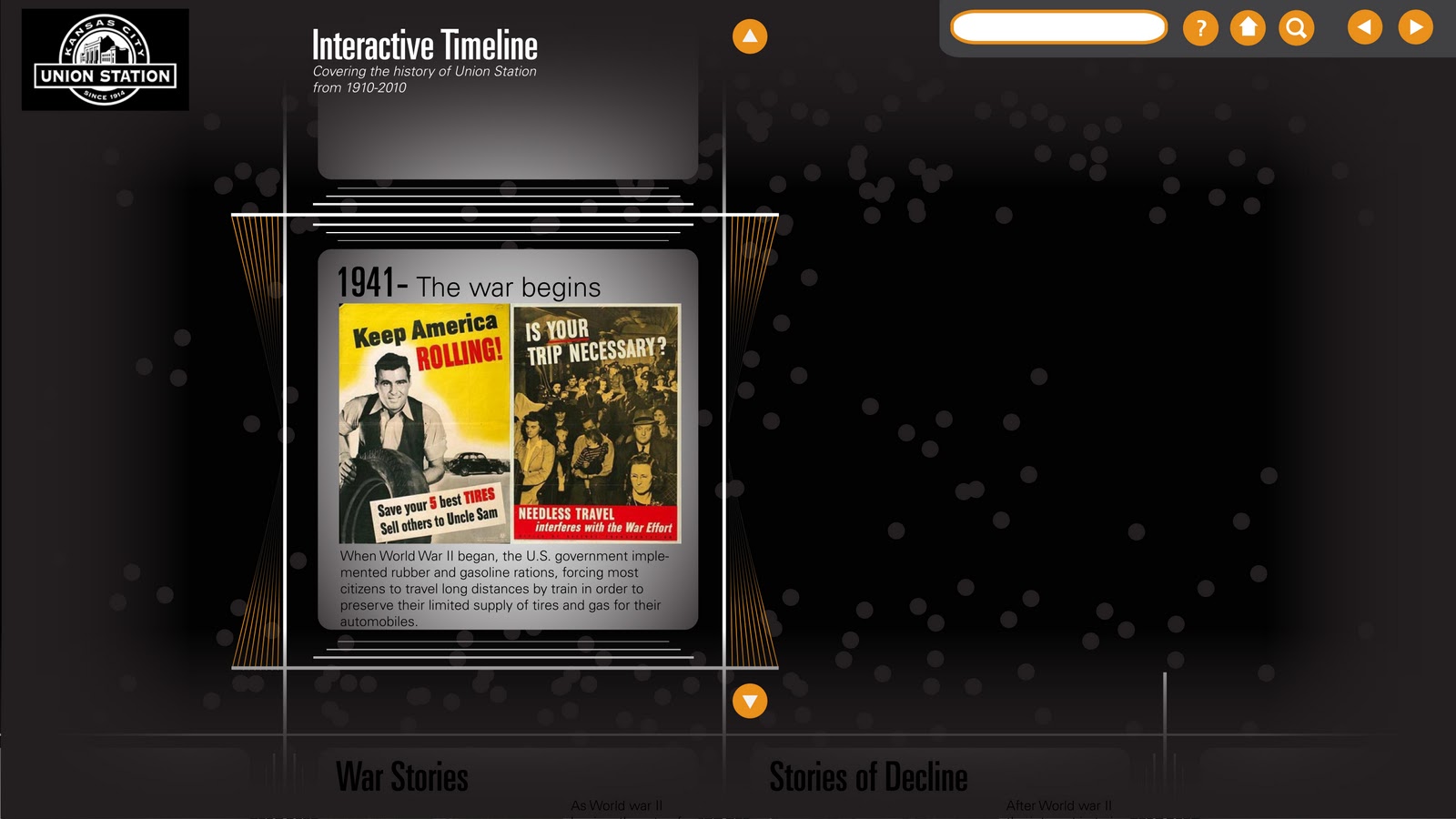
Moving forward this has been created with a combination of the two concepts we had.
Clarity and simple functionality, union station color schemes, and a more creative interface has merged.

New Article Screen.
Larger view, more space for text, with a system of icon and way finding.
Major adjustments to simplify are currently in the works!
October 7, 2011
Interactive Timeline Process
Design #1

1940's Home Screen

Image Selection w/ Additional Information and Slideshow
Design #2

October 3, 2011
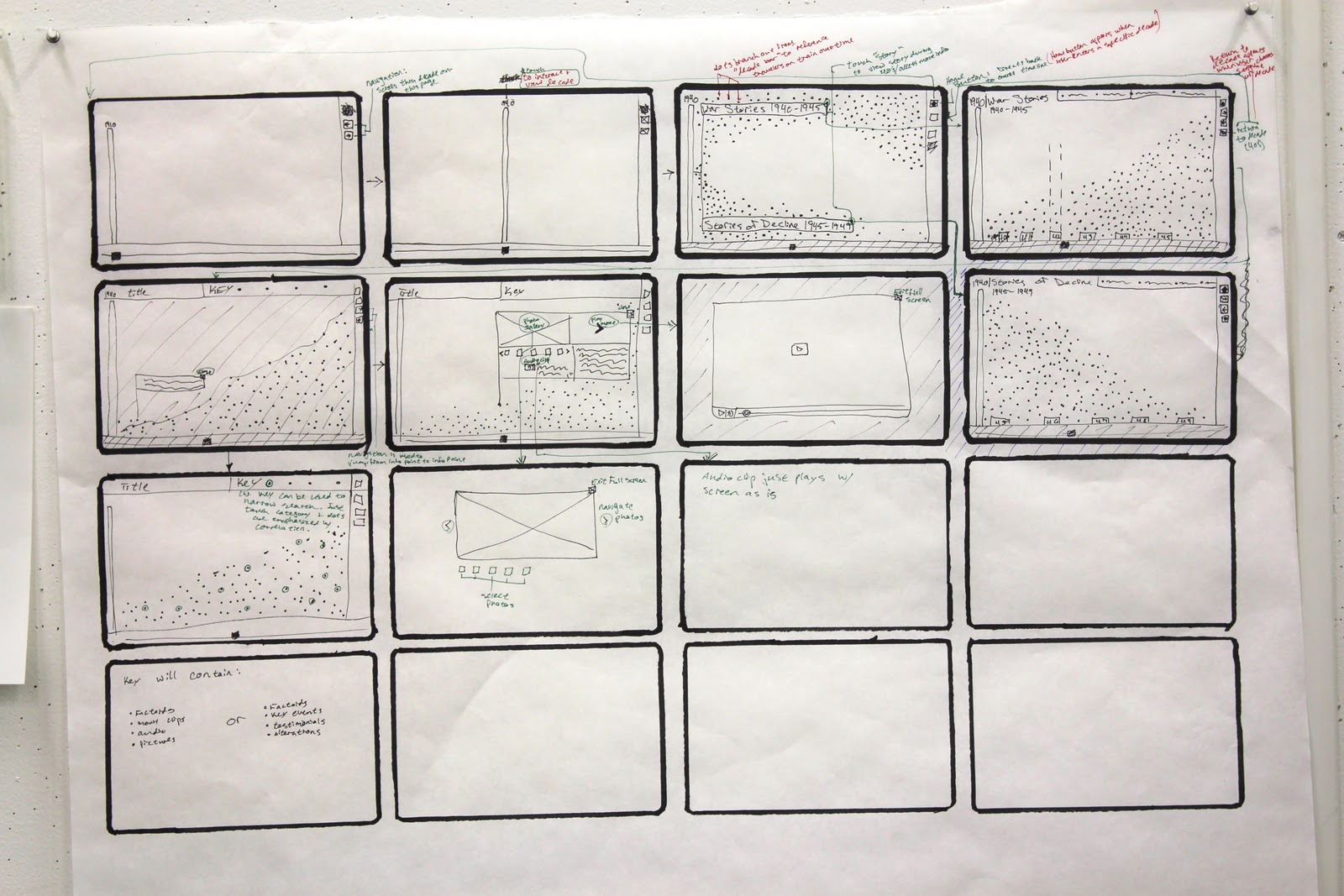
Union Station Wireframes

UI Concept #1
Interactive timeline with integrated audio, video, photograph, and testimonials. As you move through the timeline with your finger (swipe) you can scroll through the different years and events. Select an event and by the icon bellow you can tell what media it is. If that is what you want you can move forward with your selection. Photograph has an option slide show if there is more than one image with additional blurb or information. With the audio selection you have the standard audio controls layout. On the audio bar it would show you where you are so far into the audio clip. Buffer may or may not be shown. Maybe not if we don't want the viewer to think that there is a chance of it not buffering properly? Maybe it would be better if the audio was loaded to an SSD drive and then there wouldn't be any load time at all. With the video clip there is the standard video controls. In this case I only want to show pause, play, and the X for closing the box. At the bottom of the timeline there is a micro timeline view. If you select the small timeline it pops up showing a slide bar with each year of the decade its currently in and highlighting which one you're currently on. In the top right corner there is an icon for expand. When you select this icon is opens up the macro view. In the macro view you see each decade as a cropped sliver of an image that is highlighting one of the most important moments in that decade. They would function as a cycling / rotating view controlled with a swipe motion and tap to close. At the bottom of the page there is a check box for infographic view. With this selected as you move through the normal timeline each selection that you scroll through at the bottom of the page on top of the micro timeline bar an infographic highlight of that years tickets sold, and trains run through the station. The years prior and after the year selected are shown leading the viewer to continue on through the timeline as well as informing them of the rise and decline in an interesting visual graph.
UI Concept #2
September 30, 2011
Union Station 1940's Timeline Notes
UNION STATION TIMELINE
Narratives: Wartime & The Long Decline
Audience: Families and students that visit Union Station.
* Music from the 1940’s
WARTIME:
Union Station Information from main website:
1945: Passenger traffic hits a record 678,363 travelers w/ a significant numbers of armed forces personal passing through Union Station on their way home from WW II.
1940?: The era of R.A. Long. Lumber Baron, developer, investor, newspaper owner, millionaire, philanthropist, ends.
Union Station has a collection of significant items that represents the history of Kansas City.
Union Station Kansas City Book:
Gasoline and rubber rationing made trains more popular. pg. 140
The numbers of tickets sold: 365,780 to 1,169,995. pg. 140
Train passenger volume swelled in 1940 from 59,474 to 72,302 at the wars end. pg. 140
Any trains that were less than 40% full were shut down by the Office of Defence Transportation. pg. 140
Waiting room resembled an army camp.
The loud speaker comes on and announces that we were attacked at Pearl Harbor and the United States have declared war on Japan and Germany. An African American women started singing “God Bless America The Land That I Love”. There are two different sources that this fable comes from. Two different women that it could have been. Marian Anderson and Pearl Bailey. Neither of them mention it in their autobiography. The Union Station didn’t have loud speakers at the time and thus debunks the myth. Either fact or fiction it embodied the spirit of the American passengers and the tension between the situation at hand. pg. 140
The marriage factory - A temporary mating ritual. In the crowd at the gates a man and a women traveling alone locked eyes. The soldier knew the women’s predicament: Little chance of getting on board. Without a word spoken, he motions the women over and gets her through the military check point with him. He flirted with her but then they went their separate ways.
Travelers aid society. 1,000 requests a day. For money they could use for food and directions.
Upstairs at the ticket counters women were given jobs for the first time. People would try to take advantage of them.
Right after the war ended business took a holiday across the city and the Fred Harvey restaurant at union station had 60 - 100 people in line constantly.
When the war was declared over people rejoiced while they were waiting.
MISC.
People were being torn apart from one another. A very emotional sight to see.
They handled airplane motors, and 2,000 lbs bombs. Other than that they were not outfitted for military production or support. pg. 148
It wasn’t very patriotically embellished. People were so busy with travelling they didn’t really have time for patriotic embellishments. pg. 148
the 1940’s was the busiest Union Station ever was.
Mail was the largest cargo business at the time. pg. 148
Christmas day in 1943 seven dozen boxcars stuffed with holiday greeting sat on the sidings around the station’s grounds. Waiting to be unloaded. Not enough man power was to be found to help unload everything in time. pg. 149.
It was connected to a post office. See above.
They sorted 2,000,000 feet of catalogs and letters in one week. During the Christmas season it was just worse.
1945 - News came over the loud speakers that the war had ended. pg. 150.
TESTIMONIALS:
Bill Lawrence
Sally Martin Rice
David Pence
Walter Lewis
Edna Sutton
Isak Federman
THE LONG DECLINE:
“Heady years after World War II masked the oncoming decrease in rail passenger travel.” pg. 160
Week before Christmas 1947: Charles Clancy had been there since the beginning, first as a train caller, then as an assistant stationmaster, and now as a stationmaster. He had been there since the first days when every Kansas city citizen rushed to see the new industrial palace. He had been there in the late ‘20s, too, when the palace was packed with and he had wrestled a steer to the marble floor. He had been there during the depression, when the crowds dwindled, and during the second world war, when they re-emerged. And now again post holiday seemed to signal a return to peacetime prominence. pg. 158
1947: Shoppers waited in line inside Harvey stores to order Christmas gifts. Yes, the station was humming, back to normal, back to the way it used to be. That old adage that you couldn’t go back to union station without seeing someone you knew held true. Sure, train traffic had dipped from the war years but who didn’t expect that? War rationing had ended, troop movements slowed to a trickle, and car sales had bounced back after being all but nil during the war years. Yet people were still riding the rails. Better yet, they were riding more than during the depression, more at least at Union Station than any year since 1930. pg. 158
The passenger train business was shriveling up. The postwar slowdown that was inevitable after trains’ wartime dominance turned out to be the start of a precipitous decline. The number of passengers nationally dropped 13 straight years, to about one-third of the wartime peak. During this period, too the city of Kansas City suffered its own slide, plunging from the ranks of Americas’ top 20 metropolises as its urban neighborhoods hollowed out. pg. 161
These were obvious signs for Kansas City’s beloved train depot. For, if there was one constant in its life, it was this as go the railroads and the city so goes Union Station. pg. 161
Santa Fe launched a new stream liner out of Kansas City, the Kansas City Chief, with overnight service between Union Station and Chicago . The Kansas City Southern, too, re-equipped its southern belle and cut the running time to New Orleans by 14%. pg. 161
These bright spots, however, became momentary blips in an otherwise bleak business. From the wartime peak of nearly 1 billion passengers, the number of train travelers nation-wide fell below 800 million in 1946. bellow 600 million in 1949, and bellow 400 million in 1957
Tickets Sold & Trains Handled:

The arrived in 1949 to study the Fred Harvey operations. Restaurant revenue was down one-third since the war. Sessions reported, and the eateries no longer turned a profit. pg. 166
“Failure to modernize will be accompanied by the risk of gradual deterioration of the remarkably high prestige which Fred Harvey enjoy in Kansas City.” - 1949 study by consultants. pg. 166
QUESTIONS TO ASK:
Who was R.A. Long? What was his impact on the Union Station in 1940.
Did they transport any other materials other than soldiers.
Do they have a passenger manifest or log? A documentation of passengers transported, tickets sold, trains used, etc.
Were there ever fights for seats on the train?
Who created Union Station? Who designed it? Who’s idea was it?
Where there any buildings created to aid in transportation during the 40’s?
How long have the collection series been around?
Any relations to Corinthian Hall?
What year did Fred Harvey restaurant open?
Did some mail just get trashed due to backup?
NOTES FROM LECTURE:
The biggest time for union station.
One of two of every soldier that was leaving the us passed through Union Station.
Period of the most trains.
Period of the most passengers.
Harvey dining house was open on VJ day when most others weren't.
Union Station became a facility to support the war effort.
People would come to the Union Station to see the news reels about the war before movies.
Early 40’s the starts would come from the east coast to the west coast and would stop in Kansas City.
The 40’s was an era of sadness with families being torn apart so the men could go off to war.
Narratives: Wartime & The Long Decline
Audience: Families and students that visit Union Station.
* Music from the 1940’s
WARTIME:
Union Station Information from main website:
1945: Passenger traffic hits a record 678,363 travelers w/ a significant numbers of armed forces personal passing through Union Station on their way home from WW II.
1940?: The era of R.A. Long. Lumber Baron, developer, investor, newspaper owner, millionaire, philanthropist, ends.
Union Station has a collection of significant items that represents the history of Kansas City.
Union Station Kansas City Book:
Gasoline and rubber rationing made trains more popular. pg. 140
The numbers of tickets sold: 365,780 to 1,169,995. pg. 140
Train passenger volume swelled in 1940 from 59,474 to 72,302 at the wars end. pg. 140
Any trains that were less than 40% full were shut down by the Office of Defence Transportation. pg. 140
Waiting room resembled an army camp.
The loud speaker comes on and announces that we were attacked at Pearl Harbor and the United States have declared war on Japan and Germany. An African American women started singing “God Bless America The Land That I Love”. There are two different sources that this fable comes from. Two different women that it could have been. Marian Anderson and Pearl Bailey. Neither of them mention it in their autobiography. The Union Station didn’t have loud speakers at the time and thus debunks the myth. Either fact or fiction it embodied the spirit of the American passengers and the tension between the situation at hand. pg. 140
The marriage factory - A temporary mating ritual. In the crowd at the gates a man and a women traveling alone locked eyes. The soldier knew the women’s predicament: Little chance of getting on board. Without a word spoken, he motions the women over and gets her through the military check point with him. He flirted with her but then they went their separate ways.
Travelers aid society. 1,000 requests a day. For money they could use for food and directions.
Upstairs at the ticket counters women were given jobs for the first time. People would try to take advantage of them.
Right after the war ended business took a holiday across the city and the Fred Harvey restaurant at union station had 60 - 100 people in line constantly.
When the war was declared over people rejoiced while they were waiting.
MISC.
People were being torn apart from one another. A very emotional sight to see.
They handled airplane motors, and 2,000 lbs bombs. Other than that they were not outfitted for military production or support. pg. 148
It wasn’t very patriotically embellished. People were so busy with travelling they didn’t really have time for patriotic embellishments. pg. 148
the 1940’s was the busiest Union Station ever was.
Mail was the largest cargo business at the time. pg. 148
Christmas day in 1943 seven dozen boxcars stuffed with holiday greeting sat on the sidings around the station’s grounds. Waiting to be unloaded. Not enough man power was to be found to help unload everything in time. pg. 149.
It was connected to a post office. See above.
They sorted 2,000,000 feet of catalogs and letters in one week. During the Christmas season it was just worse.
1945 - News came over the loud speakers that the war had ended. pg. 150.
TESTIMONIALS:
Bill Lawrence
Sally Martin Rice
David Pence
Walter Lewis
Edna Sutton
Isak Federman
THE LONG DECLINE:
“Heady years after World War II masked the oncoming decrease in rail passenger travel.” pg. 160
Week before Christmas 1947: Charles Clancy had been there since the beginning, first as a train caller, then as an assistant stationmaster, and now as a stationmaster. He had been there since the first days when every Kansas city citizen rushed to see the new industrial palace. He had been there in the late ‘20s, too, when the palace was packed with and he had wrestled a steer to the marble floor. He had been there during the depression, when the crowds dwindled, and during the second world war, when they re-emerged. And now again post holiday seemed to signal a return to peacetime prominence. pg. 158
1947: Shoppers waited in line inside Harvey stores to order Christmas gifts. Yes, the station was humming, back to normal, back to the way it used to be. That old adage that you couldn’t go back to union station without seeing someone you knew held true. Sure, train traffic had dipped from the war years but who didn’t expect that? War rationing had ended, troop movements slowed to a trickle, and car sales had bounced back after being all but nil during the war years. Yet people were still riding the rails. Better yet, they were riding more than during the depression, more at least at Union Station than any year since 1930. pg. 158
The passenger train business was shriveling up. The postwar slowdown that was inevitable after trains’ wartime dominance turned out to be the start of a precipitous decline. The number of passengers nationally dropped 13 straight years, to about one-third of the wartime peak. During this period, too the city of Kansas City suffered its own slide, plunging from the ranks of Americas’ top 20 metropolises as its urban neighborhoods hollowed out. pg. 161
These were obvious signs for Kansas City’s beloved train depot. For, if there was one constant in its life, it was this as go the railroads and the city so goes Union Station. pg. 161
Santa Fe launched a new stream liner out of Kansas City, the Kansas City Chief, with overnight service between Union Station and Chicago . The Kansas City Southern, too, re-equipped its southern belle and cut the running time to New Orleans by 14%. pg. 161
These bright spots, however, became momentary blips in an otherwise bleak business. From the wartime peak of nearly 1 billion passengers, the number of train travelers nation-wide fell below 800 million in 1946. bellow 600 million in 1949, and bellow 400 million in 1957
Tickets Sold & Trains Handled:
The arrived in 1949 to study the Fred Harvey operations. Restaurant revenue was down one-third since the war. Sessions reported, and the eateries no longer turned a profit. pg. 166
“Failure to modernize will be accompanied by the risk of gradual deterioration of the remarkably high prestige which Fred Harvey enjoy in Kansas City.” - 1949 study by consultants. pg. 166
QUESTIONS TO ASK:
Who was R.A. Long? What was his impact on the Union Station in 1940.
Did they transport any other materials other than soldiers.
Do they have a passenger manifest or log? A documentation of passengers transported, tickets sold, trains used, etc.
Were there ever fights for seats on the train?
Who created Union Station? Who designed it? Who’s idea was it?
Where there any buildings created to aid in transportation during the 40’s?
How long have the collection series been around?
Any relations to Corinthian Hall?
What year did Fred Harvey restaurant open?
Did some mail just get trashed due to backup?
NOTES FROM LECTURE:
The biggest time for union station.
One of two of every soldier that was leaving the us passed through Union Station.
Period of the most trains.
Period of the most passengers.
Harvey dining house was open on VJ day when most others weren't.
Union Station became a facility to support the war effort.
People would come to the Union Station to see the news reels about the war before movies.
Early 40’s the starts would come from the east coast to the west coast and would stop in Kansas City.
The 40’s was an era of sadness with families being torn apart so the men could go off to war.
September 19, 2011
Tender Buttons Animation
First video I uploaded was short for some reason so I have since re uploaded a new version that uses the correct time limit.
September 16, 2011
Tender Buttons Animation Adjustments
After last class critique I am experimenting with some adjustments to my video.
Some changes I am experimenting with:
Some changes I am experimenting with:
- Adjusting the speed at which my type revels its self from behind the mask.
- Trying other axis locations and directions.
- Adjusting typographic hierarchy to match the book better.
- Variation of wiggle speeds.
- Experimenting with the order in which my type fades from the screen.
- Trying a rotating title for each poem to reference my double sided book foldout.
September 10, 2011
Tender Buttons Animation Update

Title screen reference.
This text fades in and out.
While visible it has a slight shake to it.

Type coming out from behind a mask at varying speeds.
There will not be a traditional order behind this as the lines of text come out you will have the ability to read it in variing order until its completely unhidden.
I will be doing this to represent a sense of growth and typographic evolution.
The text has a slight shake to it that isn't being shown here.

This is an example of the structure of the poem I will be referencing.
August 25, 2011
Type In Motion / Fine + Share - The Universal Declaration of Human Rights
The Universal Declaration of Human Rights from Seth Brau on Vimeo.
Here is a pretty fantastic kinetic typography video based on the UDHR.
More information about The Universal Declaration of Human Rights.
The actual UN declaration can be found here.
Subscribe to:
Posts (Atom)
