
Showing posts with label TYPOGRAPHY III. Show all posts
Showing posts with label TYPOGRAPHY III. Show all posts
December 5, 2011

November 28, 2011
Pierre Koenig Living With Steel - Final Book
Pierre Koenig Living With Steel by Eli Brumbaugh | Make Your Own Book
Pictures coming as soon as I get it in the mail!
Pictures coming as soon as I get it in the mail!
November 11, 2011


October 14, 2011
Koenig Book Spreads


My conept for the Koenig book is based on the idea of referencing architectural drawings. Line work comes off of the imagery where appropriate to resemble the blue prints. These same lines are being used to lead your eye into the start of paragraphs. I have decided to slice images at the start of a new section revealing a little of the image and giving the text an interesting place to sit and interact with the image to create energy. My paragraphs are focused around other paragraphs or pull quotes to create a sense of negative space on the page that could resemble rooms in a house using a top down view. The images themselves have been treated using a few filters to create a more vintage and attention grabbing feel depending on the time of day they were shot in. My pull quotes are resting on a black shape to create a strong sense of contrast that can also interact with the rest of the content by being shaped by it.
October 7, 2011


October 6, 2011
Koenig Spreads Round 1

first step in some overhauls.
Directional adjustments before class ended:
Bumped the grid up to 13 columns simply to have a grid to work with like "graph paper" which so far has been working much better.
Editing images is alright to do so long as it isn't constantly done.
I bumped my text from 12/13 to 11/13, and last but not least 10.5/13
Currently there is a 0.0425 space after as well.
The spread above is richer in contrast and hierarchical diferences.
Changes to make still:
More interesting compositions and text adjustments.

Practice spread 1 of 3

Practice spread 2 of 3
September 23, 2011
Tender Buttons Final
Objects in Space. An Anthology of Poems by Gertrude Stein.
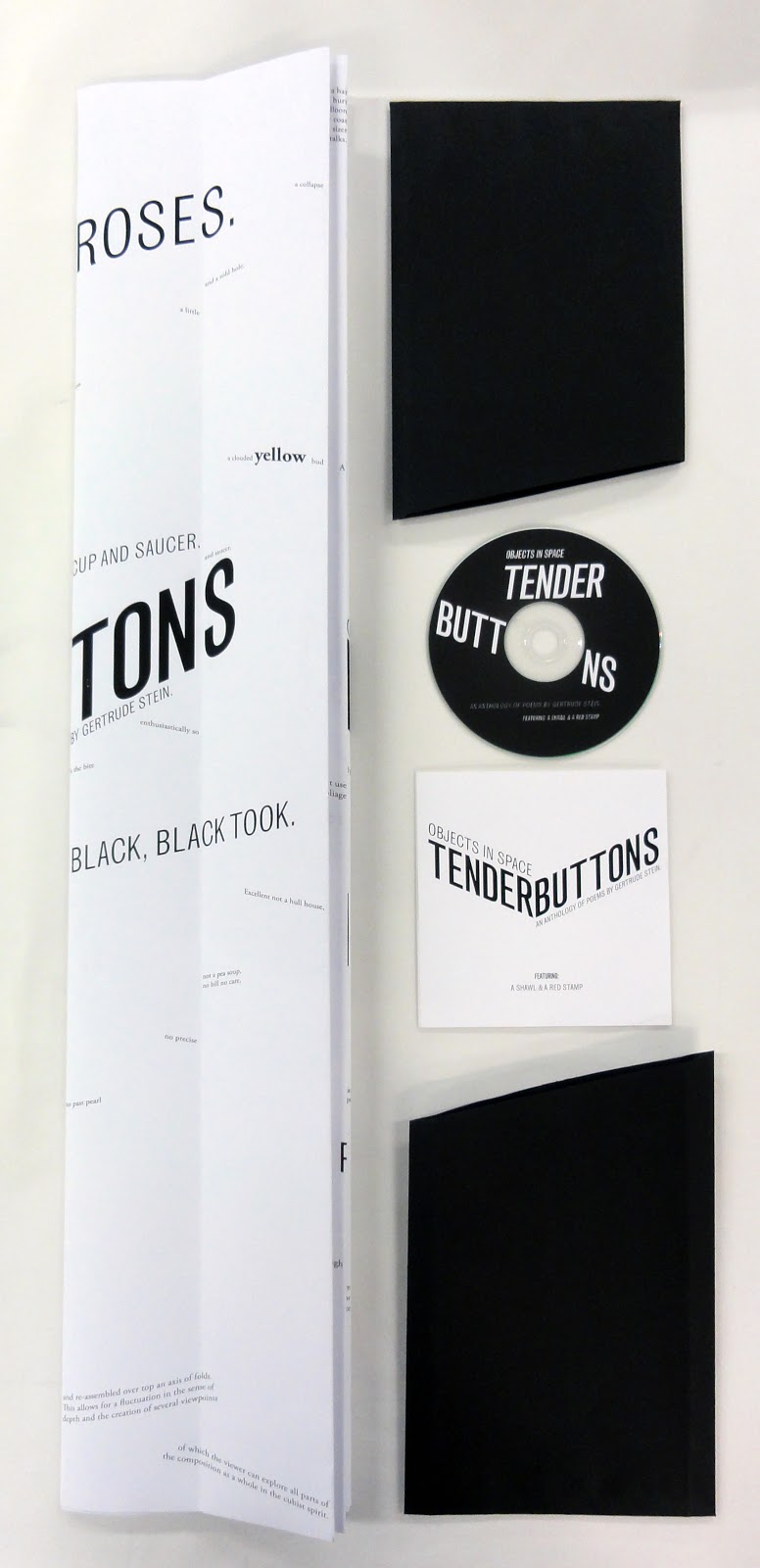
I chose to name my anthology "Objects in Space" because every poem that I selected is from the Objects collection. These individual poems or "objects" float in the folds of the composition. Each one ideally could be arranged endlessly in a plaine that has only rules to break. The sections of text have been broken up, and re-assembled over top an axis of folds. This allows for a fluctuation in the sense of depth and the creation of several viewpoints of which the viewer can explore all parts of the composition as a whole in the cubist spirit. I chose to represent Stein's works using a visual method that could be manipulated physically by the shuffling of pages allowing the viewer to change the meaning of the message in each line. This is part of the cubist spirit that encompasses my concept. I wanted the viewer to feel that they had total control of not what Stein was saying but what they were saying at the not only as the viewer but as a fellow creator. I would like to image that had Picasso and Stein sat down together with a jumble of letters and canvas they would have composed something like this.
* Moments Book not displayed


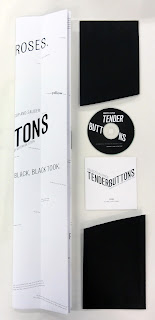


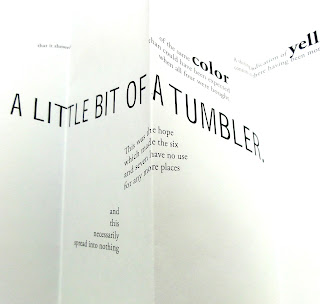


I chose to name my anthology "Objects in Space" because every poem that I selected is from the Objects collection. These individual poems or "objects" float in the folds of the composition. Each one ideally could be arranged endlessly in a plaine that has only rules to break. The sections of text have been broken up, and re-assembled over top an axis of folds. This allows for a fluctuation in the sense of depth and the creation of several viewpoints of which the viewer can explore all parts of the composition as a whole in the cubist spirit. I chose to represent Stein's works using a visual method that could be manipulated physically by the shuffling of pages allowing the viewer to change the meaning of the message in each line. This is part of the cubist spirit that encompasses my concept. I wanted the viewer to feel that they had total control of not what Stein was saying but what they were saying at the not only as the viewer but as a fellow creator. I would like to image that had Picasso and Stein sat down together with a jumble of letters and canvas they would have composed something like this.
* Moments Book not displayed




September 10, 2011
Tender Buttons Book Update After Group Critique
Projects Status Currently:
Overall Build: Book folds out into a 22x28 sized double sided poster.
Disc: The cd will be placed into a white sleeve with black text laid on top of it from the poem above it.
Changes:
- After exploring earlier fully fleshed out double sided mockup I realized that I need to reorder the pages.
- I will be adding my concept to the colophon and possibly removing the colophon title from its section as it may distract from the over all composition.
- I will be removing the page numbers on the index as this concept allows for any order of the poems to be perceived and listing them in order would add structure to the way the viewer will read the works.
Possible Changes:
- I will be exploring multiple shorter folds to allow for a easily turned page.
- I am exploring the possibility of using a black shape in the very center of the folded out book as a place to leave my title instead of using one of the "sections" reserved for Steins poems.
"Push the limits"

This is an example of the size increase from 18x24 to 22x28 in the book folded out in poster form. This will allow for larger typography use and help with clarity.

Some different title variations in the works.

Example of how the poems are organized.
August 31, 2011
Tender Buttons Research
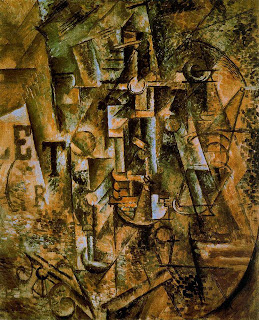
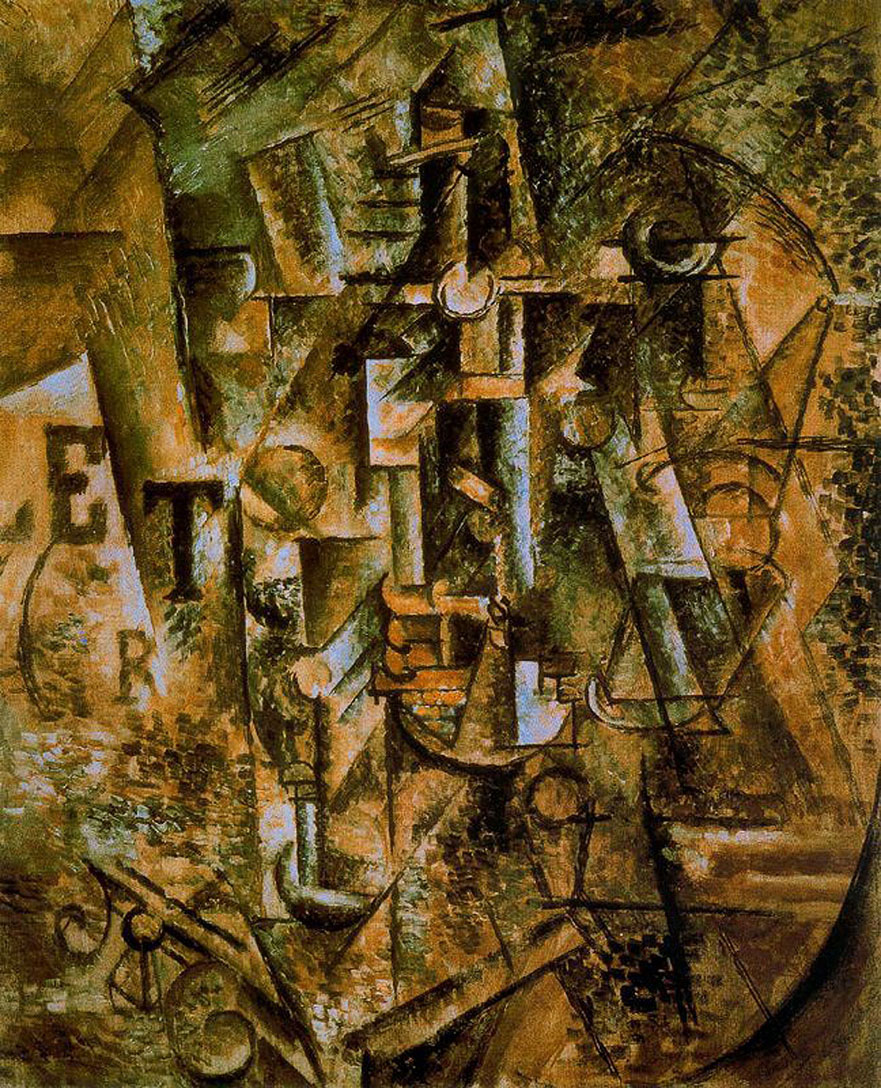
I am interested in the relationship between Stein's cubist poetry and Picasso's analytic cubist paintings. I want to know how they mutually inspired each others process and final product. I want to reflect that influence by calling out color and or Distortion based on different axis's set in the spread. In the cubist paintings much of the broken up imagery is sitting on different angles. Using a paper that is simular in color to the cubist paintings at the time. A vanilla or aged paper. If possible I would like the paper to be transparent to some extent to allow all of the poems to merge together to form one collective image like the cubist paintings that showed all sides as one.
Cubism: Objects are broken up, analyzed, re-asembled in abstract form instead of depicting objects from one viewpoint.
"In cubist artworks, objects are broken up, analyzed, and re-assembled in an abstracted form—instead of depicting objects from one viewpoint, the artist depicts the subject from a multitude of viewpoints to represent the subject in a greater context. Often the surfaces intersect at seemingly random angles, removing a coherent sense of depth. The background and object planes interpenetrate one another to create the shallow ambiguous space, one of cubism's distinct characteristics."
"The influence of cubism extended to other artistic fields, outside painting and sculpture. In literature, the written works of Gertrude Stein employ repetition and repetitive phrases as building blocks in both passages and whole chapters. Most of Stein's important works utilize this technique, including the novel The Makings of Americans (1906–08) Not only were they the first important patrons of Cubism, Gertrude Stein and her brother Leo were also important influences on Cubism as well. Picasso in turn was an important influence on Stein's writing."
Paper Size: At the moment I am thinking a 5.5in x 8.5in size pages in an 8.5 x 11 two page spread or a four page in an 11x17 that can be folded out and viewed with four poems forming the canvas of sorts.
OR a series of seperate sheets of paper that can be held together as one or multiple sets. Each would create its own cubist image.
Paper Type: Aged or vanilla colored possibly transparent paper.
Sample Spreads:


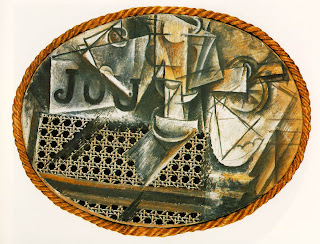
Reference Images: Picasso's analytic cubist paintings.


OR a series of seperate sheets of paper that can be held together as one or multiple sets. Each would create its own cubist image.
Paper Type: Aged or vanilla colored possibly transparent paper.
Sample Spreads:


Sample Overlap:

Reference Images: Picasso's analytic cubist paintings.


August 26, 2011


Subscribe to:
Posts (Atom)
